Platform foundation
BisQue Platform: storage, visualization, analysis, and extensibility
The BisQue platform is the scientific foundation beneath BisQue Ultra: large-scale storage, up to 5D visualization, flexible metadata, analysis modules, and reproducible workflows.
Most research software fails in a familiar way: the image lives in one place, the notes live in another, the analysis script lives in a third, and the explanation of what happened lives in someone’s memory until it disappears.
BisQue was built to resist that drift.
The official docs describe BisQue as an open-source web-based platform for scientific image storage, visualization, machine-learning-based analysis, and reproducible workflows. That description is accurate, but it is also dense. The useful question is simpler: what problem is BisQue actually trying to solve?
It is trying to keep scientific work whole.
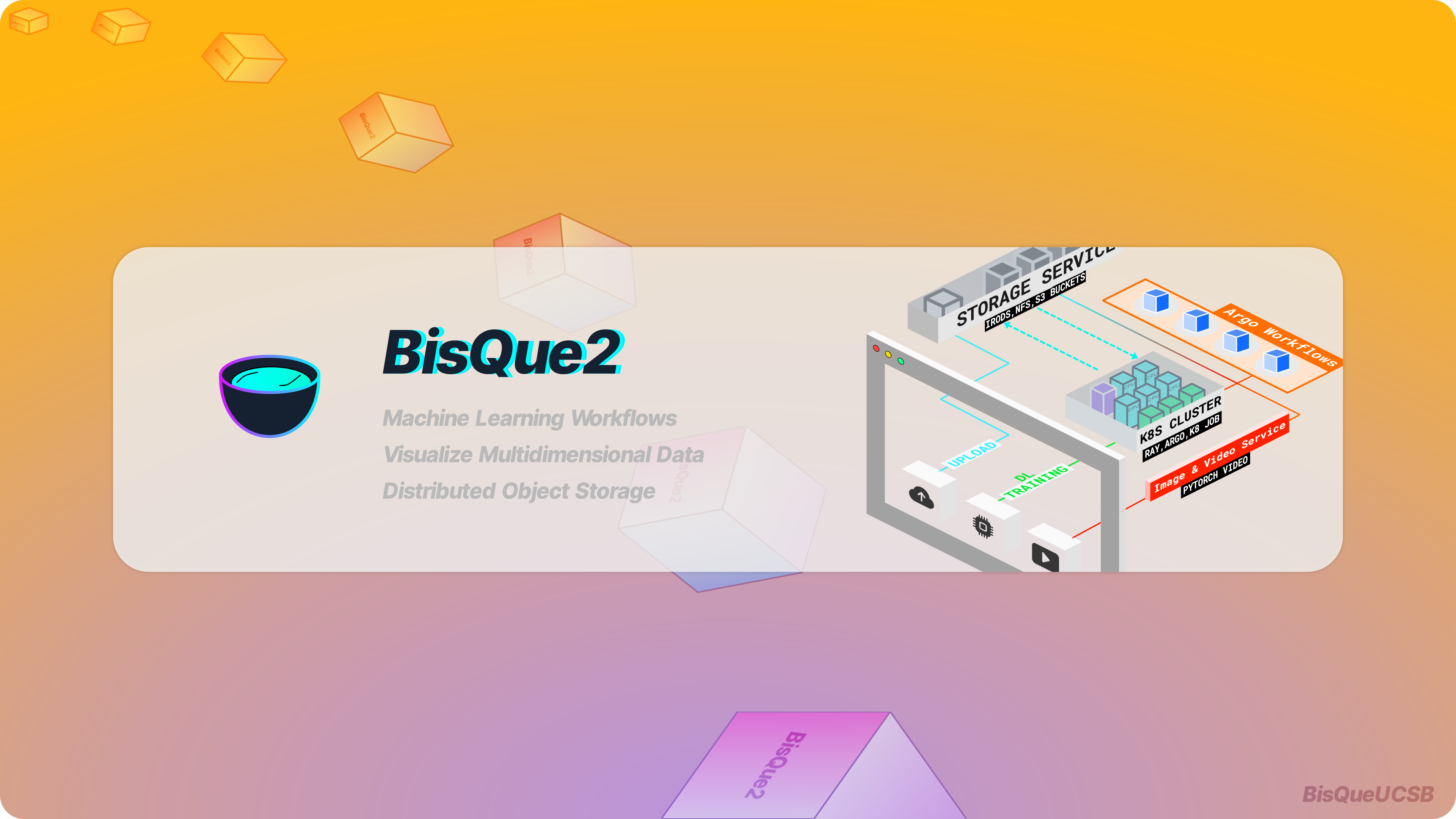
That dual identity matters. BisQue is both a tool people use and a system labs can deploy, extend, and build on.
What BisQue is really for
If you strip away the product vocabulary, BisQue is a platform for keeping scientific image work intelligible over time.
That means it has to do several things at once:
- store large scientific image collections without treating them like generic files
- let users see and inspect the data in the form researchers actually work with
- preserve metadata and annotations so interpretation is not severed from the image
- support analysis workflows, including machine learning methods
- let teams extend the system when their research outgrows a fixed feature set
Each of those goals is useful on its own. Together, they form a more important claim: BisQue is infrastructure for multi-step scientific work.
That distinction matters. A viewer can show an image. A repository can keep a file. A script can run an analysis. BisQue is trying to hold those actions in one environment so the scientific meaning does not fragment every time the work advances to the next step.
Storage is only useful if the data can still be seen
The docs emphasize storage at serious scale, including petabyte-scale data management. That sounds like an infrastructure feature, and it is, but storage in science is never only about capacity.
Stored data that cannot be inspected quickly becomes archival weight. Stored data that has lost its context becomes risk. Stored data that is visually inaccessible might as well be absent when a researcher is trying to answer a concrete question.
BisQue handles storage and visualization as related problems. That is one of its clearest strengths.
The platform is designed for up to 5D image data, which matters because scientific images carry depth, time, channels, and other dimensions that change how the image should be interpreted. A system built for ordinary media quickly breaks down under those conditions. BisQue starts from the reality that scientific imagery behaves differently from consumer imagery.
Large-scale storage
The platform is designed for serious scientific collections, which means storage is treated as an operational requirement rather than a convenience feature.
petabyte-scale postureUp to 5D imagery
BisQue is built for the dimensional complexity of scientific imaging rather than flat image browsing alone.
up to 5DVisual inspection
Images remain viewable and interpretable inside the same system that stores them, which keeps storage useful in practice.
browse + inspectWorkflow continuity
Storage, viewing, and later analysis are connected, so researchers do not have to rebuild context at every step.
one platform workspace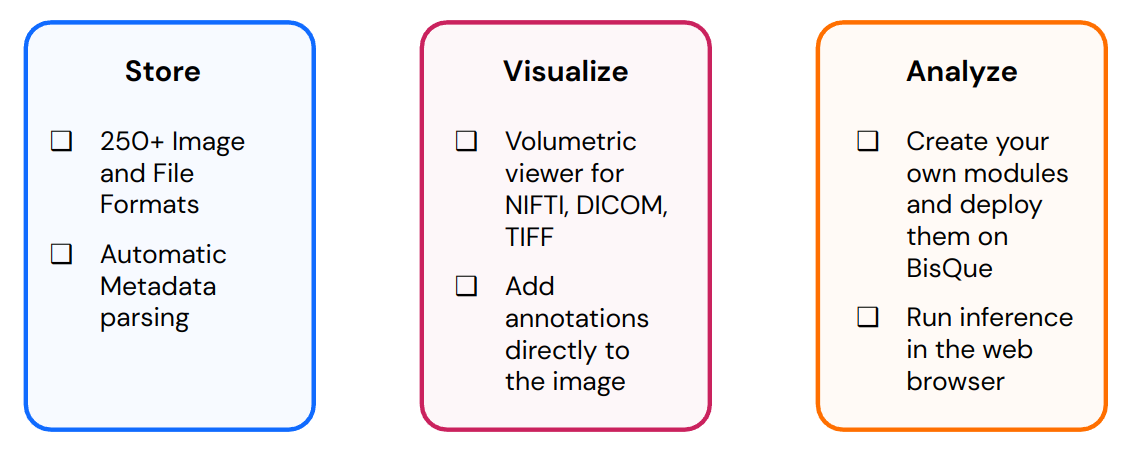
The interface shown in the docs is a scientific workspace where navigation, inspection, and context remain adjacent.
Metadata is not paperwork. It is part of the experiment.
Many systems treat metadata as a clerical afterthought. BisQue does not. The docs repeatedly point to flexible metadata as one of the platform’s core ideas, and that is exactly right.
In research, metadata answers the questions that make data usable:
- what is this image
- where did it come from
- what does this region mean
- which dataset does it belong to
- what analysis has already been run
- how should another researcher interpret what they are seeing
Without those answers, a stored image becomes increasingly ambiguous. With them, it becomes part of a recoverable scientific record.
The same is true for annotations. Textual annotations keep explanation close to the data. Graphical annotations make interpretation visible instead of merely implied. Together, metadata and annotation do something simple and powerful: they keep context from evaporating.
That is why the docs’ emphasis on a flexible metadata facility is scientific-method language. If context is rigid, scientific work gets flattened. If context is flexible, the platform can adapt to the research instead of forcing the research to adapt to the platform.
Modules turn a platform into a research instrument
A platform becomes valuable in research when it can absorb new methods without breaking its core model. BisQue does that through its open architecture and module system.
This is one of the most important ideas in the documentation, because it explains why BisQue remains useful beyond its base feature set. Labs do not all analyze data the same way. They do not use the same pipelines, the same models, or the same experimental logic. A closed platform eventually becomes a ceiling.
BisQue is designed to avoid that ceiling.
Researchers can build custom modules and run analysis workflows that take advantage of machine learning and domain-specific methods. The point is not only that the platform supports extensions. The point is that the platform expects research to evolve and gives teams a place to put that evolving work.
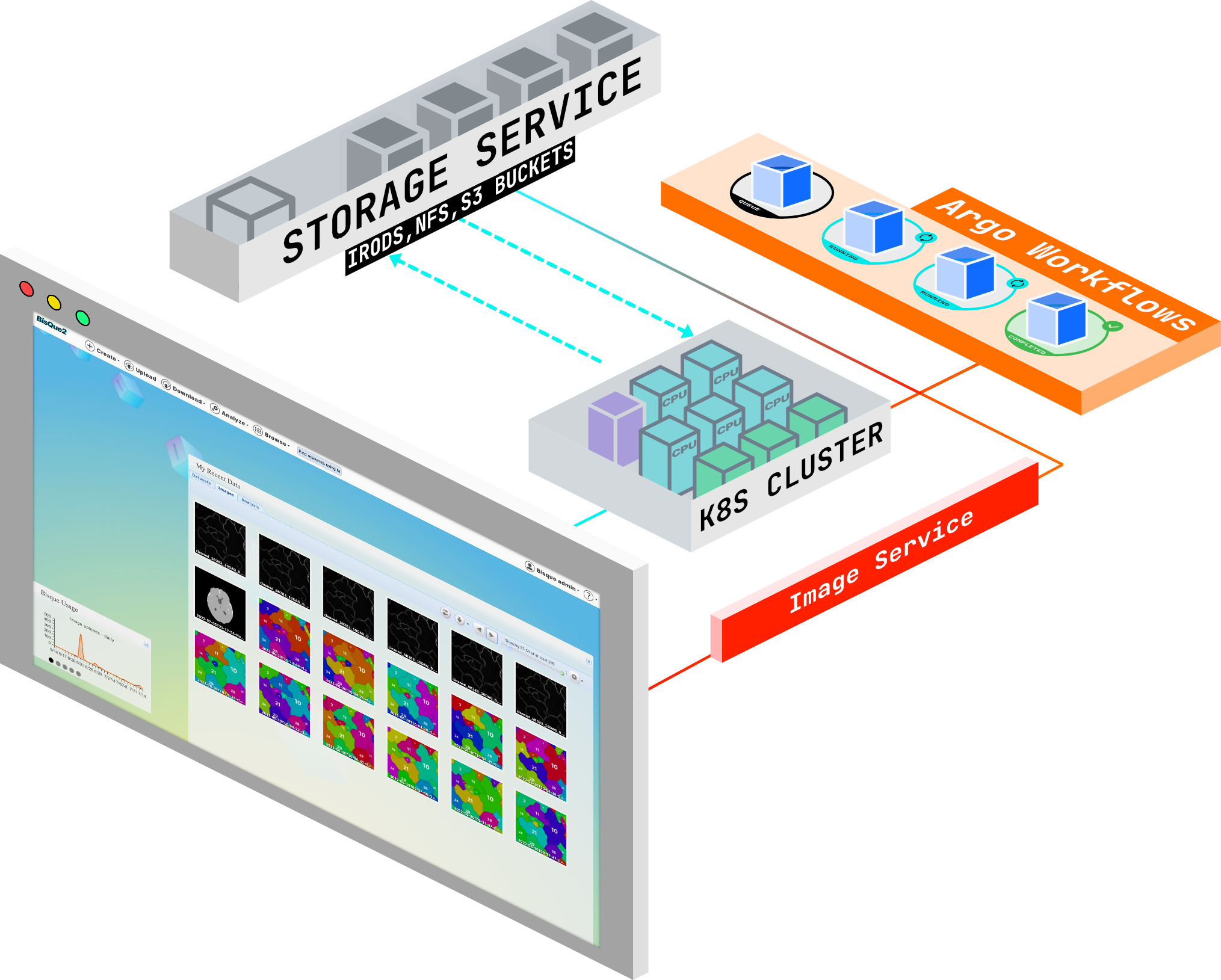
The docs make the platform logic plain: services, interfaces, metadata, and modules are arranged so new analysis capability can be added without turning the system into a patchwork.
There is a practical lesson here. If storage preserves the data and metadata preserves the meaning, modules preserve momentum. They allow a team to move from “we have data” to “we have a method” without leaving the platform that already holds the rest of the scientific context.
The docs are organized around real work
One of the best things about the official documentation is that it points people quickly toward the tasks they actually need to complete.
For researchers, the main paths are clear:
That structure works because it follows the natural order of scientific interaction. First the data has to exist in the platform. Then it has to be seen. Then it has to be analyzed.
Good documentation describes features and teaches sequence. BisQue’s docs do that reasonably well, and the sequence itself reveals something about the platform: BisQue is designed around research workflow rather than a flat catalog of disconnected capabilities.
BisQue is also for the people who build the system
The documentation also makes a second audience visible: deployers, integrators, and developers.
That audience matters more than many product sites admit. Research software survives when institutions can run it, extend it, and adapt it to local needs. BisQue takes that seriously. The docs expose practical paths for:
This is where BisQue stops feeling like a hosted tool and starts feeling like a platform in the stronger sense. It can be operated. It can be extended. It can become part of a lab’s real infrastructure.
That design choice has consequences. A deployable, scriptable, module-friendly system is much more likely to support long-term scientific use than a polished interface that cannot be adapted once research needs change.

The contributor-facing materials underline a larger truth: scientific platforms last when they invite extension, not when they hide their structure.
Why this article matters to BisQue Ultra
BisQue Ultra is easier to appreciate once you understand what it is standing on.
Ultra’s resource workflows, artifact lineage, model lifecycle, and durable execution make more sense in light of the BisQue platform beneath them. BisQue Ultra inherits real scientific foundations: storage at scale, multidimensional viewing, flexible metadata, annotations, modules, reproducible workflows, and a deployment path serious teams can operate.
That is the lasting lesson of BisQue. The platform treats images as scientific objects with memory, context, method, and consequence. That is why it remains useful, and that is why it deserves to be read closely.