Data model
Images, annotations, metadata, and analysis stay together.
Raw pixels are one part of the research record. BisQue keeps the rest — annotations, provenance, derived results — attached to the same resource.
Scientific image informatics for reproducible computer vision.
BisQue is the lab’s scientific image platform: a browser-based environment for storing, searching, annotating, visualizing, and analyzing scientific images with extensible modules and flexible metadata. In production pilot use it has absorbed nearly six million image uploads and 12.3 million annotations — and it is the catalog BisQue Ultra's research agent operates on.
Data model
Images, annotations, metadata, and analysis stay together.
Raw pixels are one part of the research record. BisQue keeps the rest — annotations, provenance, derived results — attached to the same resource.
Demonstrated scale
Nearly 6M image uploads and 12.3M annotations.
The production pilot has absorbed real demand at that scale, on an architecture built for PB-scale collections and large 5D images.
Translation
New methods move from paper to shared analysis module.
A published method becomes a module other researchers run in the browser — no rebuilt computational stack, no private pipeline.
Workshop evidence
The Winter 2025 workshop material makes the product story concrete: large mosaics, multidimensional viewers, containerized workflows, and module outputs can sit inside one shared image-informatics workspace.
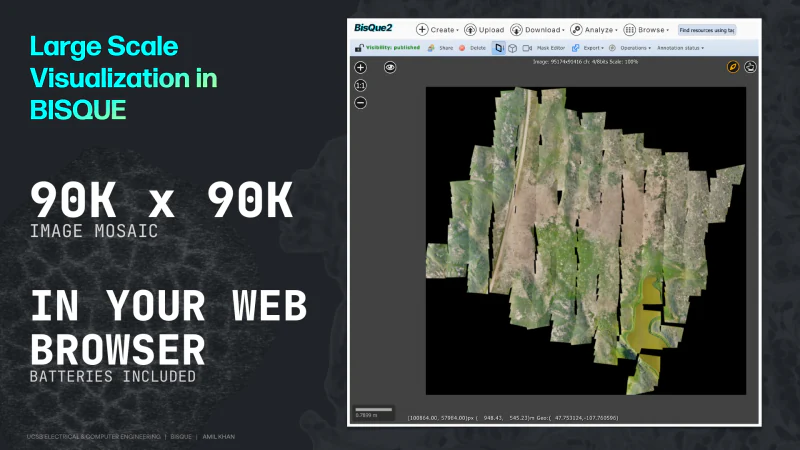
Scale
The workshop shows a 90K by 90K image mosaic in BisQue, making scale a product capability rather than an offline preprocessing footnote.
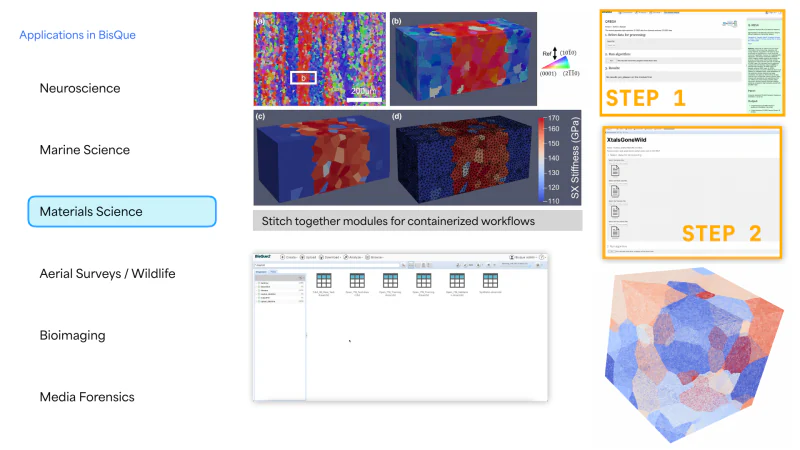
Materials science
EBSD and microstructure workflows become repeatable analysis paths with visible inputs, module steps, and derived outputs.
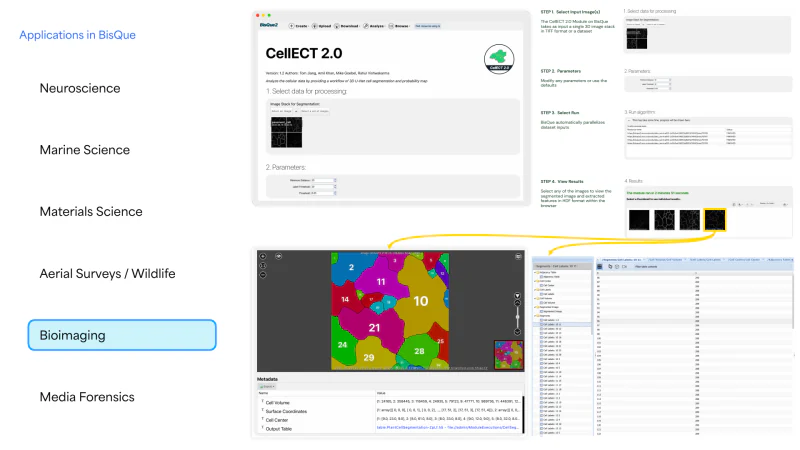
Bioimaging
Cell segmentation outputs stay connected to image viewers and table inspection, which is the practical base for reproducible bioimage analysis.
Platform capabilities
BisQue’s value is the combination of storage, metadata, visualization, annotations, and executable modules. That combination is what lets computer vision research become a reproducible scientific workflow instead of an isolated notebook.
BisQue is described as a web platform for organizing and quantitatively analyzing up to 5D image data.
The platform's metadata facility and open web architecture let researchers create, develop, and share multimodal analyses.
The public README describes cloud scalability for PB-scale images, millions of annotations, distributed storage, and large 5D images.
Researchers can extend BisQue with modules that run image analysis in MATLAB, Python, Java, and ImageJ-oriented workflows.
The platform has been used across biomedical sciences, neuroscience, wildlife conservation, marine science, and materials science.
Research Outreach describes cloud-based analytics that make analysis tools available through a web browser with light client requirements.
Connected research
MethaneMapper and WildlifeMapper expose BisQue dataset visualization links in their repositories. EBSD Superresolution and Time-lapse 3D Cell Analysis describe BisQue module paths for inference. The clinical neuroimaging papers extend the same lab pattern into MRI tumor segmentation, CT segmentation, and connectome-aware analysis.
Next layer
Ultra connects to BisQue and adds the agentic layer: a governed research agent with durable runs on Postgres and NATS JetStream, gated model training, multidimensional viewers, and a replaceable OpenAI-compatible model endpoint — measured live at 59 ms to first token.
Extend the platform
We work with teams that need shared image infrastructure, browser-visible analysis, or an agent that can operate on their BisQue resources with the evidence attached.
Primary sources